This article was first published by Washington Examiner
When I woke up Saturday morning, the first Instagram story I saw was about the passing of Sen. Lindsey Graham. I thought that’s fake news. This can’t be true, until my wife walked in and said, “Have you heard…?” I couldn’t believe it. The man was fine, touring Ukraine war zones and talking against Russia, and he is dead a day after? Call it a conspiracy, but there must be more to it.
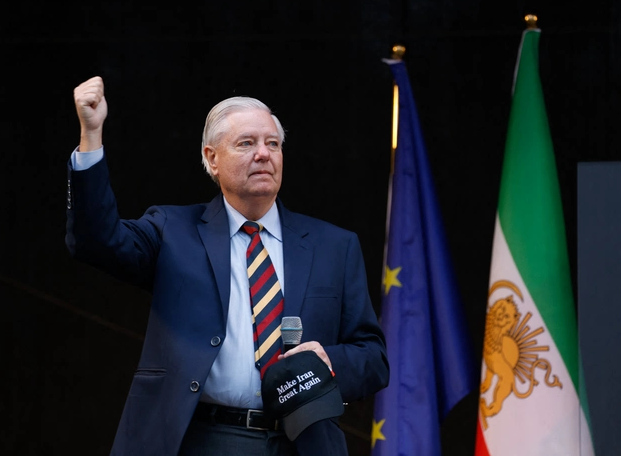
Sen. Graham had a special place in the heart of many Iranian diasporas. Iranians called him Uncle Lindsey, and he loved it. He was one of the first high-ranking officials in the U.S. government who stood behind the people of Iran and supported their efforts for freedom and regime change. He joined Iranian rallies, called for getting rid of “a murderous regime,” and held the Iranian Lion and the Sun flag in front of 250,000 people.
While for many years Iranians campaigned to convince U.S. officials and other world leaders that the Islamic Regime is a murderous regime, Sen. Graham understood this, and Iranians carried his photos in massive protests held in Los Angeles, Munich, Toronto, and other major cities.
While the FBI is assisting local authorities, I couldn’t ignore the fact that the Islamic Regime made a kill list of U.S. and Israeli officials, with large banners in Tehran saying, “We will kill Trump.” Additionally, Iranian state media and regime supporters celebrated the death of Sen. Graham.
As an Iranian who came to the United States as a refugee, fleeing the Islamic Republic, and as someone who lived for years under an Islamic dictatorship, I take the regime’s threats seriously—always. Western media may choose to dismiss these threats as propaganda, political posturing, or rhetoric intended for domestic consumption. But I cannot. I have lived under that system. I have experienced its nature firsthand. And I ultimately had to flee it to live freely.
When the Islamic Republic tells you, “We will kill you,” you should have no doubt—they mean it, and they will act on it.
Think about it in simpler, more personal terms. If you had a dispute with your neighbor and they told you, “I’m going to kill you” or “I’m going to shoot you,” what would you do? You would report it to the police. You would take it seriously. You would not dismiss it as empty talk.
So why, when the Islamic Republic openly threatens to assassinate a president, a secretary of defense, or members of a cabinet, do we hesitate to take it seriously? Why do we continue to insist on engagement, negotiation, and compromise with a regime that so clearly articulates its violent intent?
Weeks ago, President Trump declared that the ceasefire with the Islamic Republic was over—yet talks continue. In my view, the only conversation that should be taking place is how the current officials of the Islamic Republic will transfer power to the Iranian people and their true representatives. That is the only discussion worth having.
I call on President Trump and European governments to do what Senator Lindsey Graham has already begun to do: listen to the voice of the Iranian people and support their genuine representation. Now is the time for these governments to take meaningful steps to create the conditions necessary for a free and fair referendum in Iran—and for real regime change.
Let me be clear: when we speak of regime change, we do not mean simply replacing individuals. We do not mean reshuffling figures within the same system and calling it transformation. Anyone who has been part of this regime—anyone who has held a position within it—must step aside. What Iran needs is not cosmetic change, but a complete transition to a new system of governance—one that reflects the will of its people and is built on their consent.